iOS Application

iOS Application

Recall

Recall

Find your way back to anything you left behind

Find your way back to anything you left behind

SwiftUI, SwiftData, CoreLocation, MapKit, Vision, ActivityKit

SwiftUI, SwiftData, CoreLocation, MapKit, Vision, ActivityKit

Recall is an iOS app for saving a memory — a photo plus a location — and finding your way back to it later. Parked cars, meeting spots, luggage at the airport, that kind of thing. The interesting part wasn't the saving, it was the going back: GPS alone turned out to be nowhere near good enough, especially indoors or in parking structures.

Recall is an iOS app for saving a memory — a photo plus a location — and finding your way back to it later. Parked cars, meeting spots, luggage at the airport, that kind of thing. The interesting part wasn't the saving, it was the going back: GPS alone turned out to be nowhere near good enough, especially indoors or in parking structures.

The 30-second version
iOSSwiftUICoreLocation
ProblemGetting back to something you left behind, in exactly the places GPS can’t be trusted: parking structures, malls, indoors.
What I didReplaced “save one coordinate” with breadcrumb tracking, a live confidence score and a fallback mode that switches on when the signal degrades.
ResultReliable outdoors. Indoors is still inconsistent, and I say so. I’m tuning it with repeated real parking-to-mall field runs.
01 / The assumption

Save a coordinate, point an arrow. How hard could it be?

My first version saved a GPS fix and showed distance plus a compass bearing back to it. I assumed that would basically solve the problem. It didn’t. The first real tests were indoors and in parking structures, and the naive approach fell apart.

20–40 mHow far a saved location could drift indoors.
0 m movedStanding completely still, and the heading still jumped.
Right / wrongDistance looked plausible while the direction was actively wrong.
02 / See it break

Switch the signal. Watch the arrow.

This is the failure in miniature. Under weak signal, v1 trusts a single drifted fix and a noisy compass, so the arrow wobbles and points at the wrong place. v2 follows the trail you actually walked and knows when not to trust itself.

MALL / PARKING STRUCTUREYour car (real spot)Saved GPS fix
Arrow wobble
±35°
Saved-point error
20–40 m
Guidance
Raw GPS + compass

Simplified simulation of the idea, not recorded field data. White dots are raw GPS fixes; the ring is where you actually are.

03 / Decisions

Stop trusting one point. Start measuring trust.

04 / Results

Honest results, by signal condition.

Stable GPSSmooth breadcrumb trail and a reliable return path in tests.
Mixed signalUsable guidance with occasional drift. Recovery improves once stronger updates return.
Poor indoorInconsistent in real-world runs. Direction is often still usable, but path accuracy can degrade substantially.
Simulation confirmed the fallback logic, but it under-represents indoor multipath noise. So the source of truth is now repeated field runs, not the simulator.
05 / Architecture

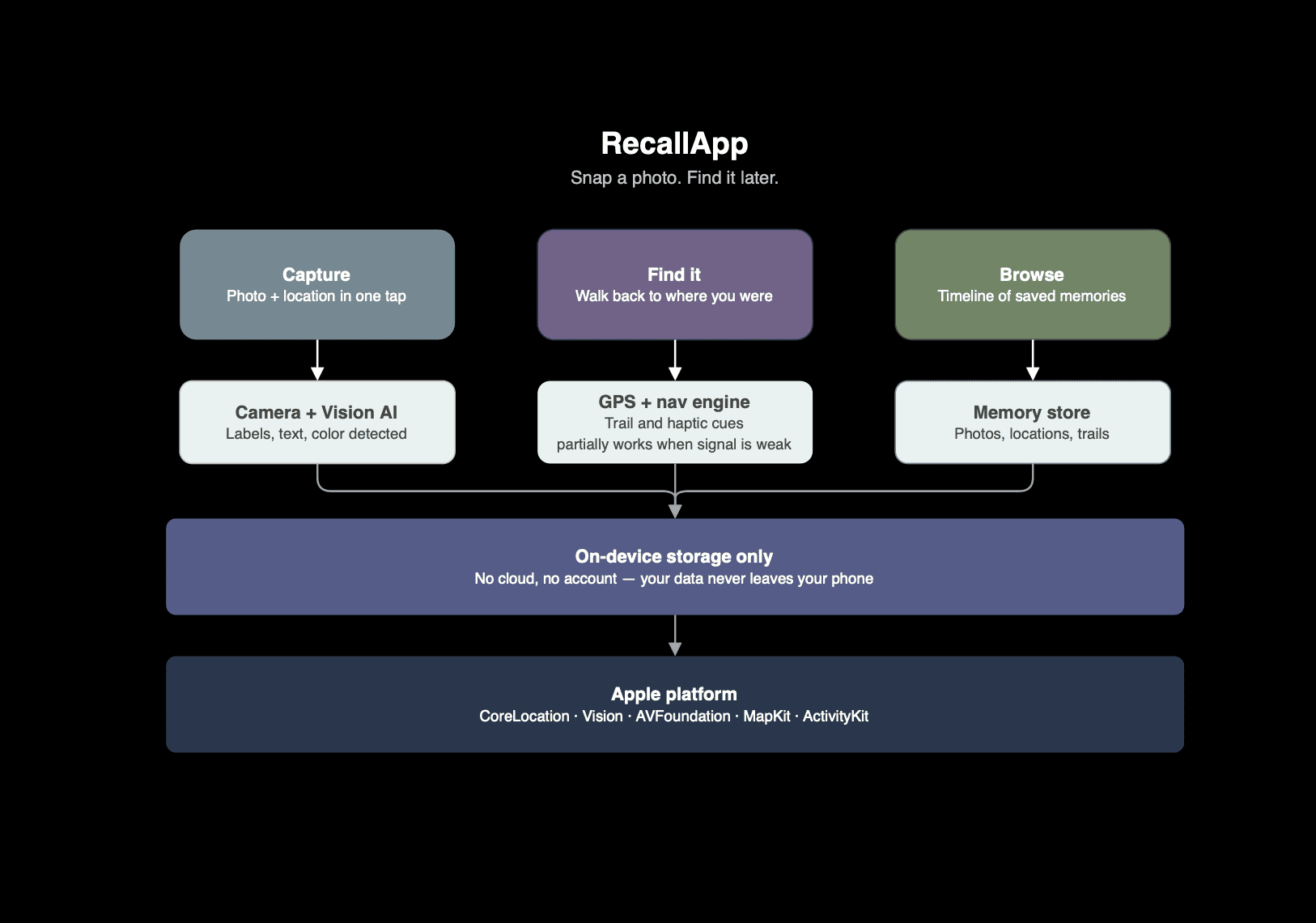
How the pieces fit.

High-level architecture. Click to enlarge.
Low-level architecture.
06 / Receipts

The demo is edited for pacing, so the raw capture is public too.

The short demo uses cuts and 2× walking segments (labelled on screen). No navigation behaviour was altered, and to back that up the unedited capture is published alongside it, with licence plates blurred for privacy.

Open to new opportunities.

View CV